The Scattering Phenomenon
Diaphanie’s diffusion tool takes direct inspiration from the way optical diffusion filters work. When placed in front of the lens, these filters generate an image made up of two components: on one side, the standard optical image formed in the usual way, and on the other, a luminous halo that spreads more or less evenly around areas of high brightness. The final result appears softened, with contours gently blurred by the spread of highlights into the surrounding regions.
The extent of this halo depends on the degree of diffusion, usually indicated arbitrarily on filters with values such as 1/8, 1/4, 1/2, 1, or 2. This effect is caused by the filter’s material structure, which introduces optical aberrations that alter the image. The glass plate, along with the particles or micro-structures embedded within it, act as obstacles to the passing light, bending its trajectory. The operation of diffusion filters therefore relies on a set of interactions between light rays and matter.
The interaction of light with an optical filter depends on several simultaneous phenomena. The first is refraction: when light passes from one medium to another, the phase velocity of the wave changes, which alters the curvature of the wavefront. This phenomenon is governed by Snell’s law and forms the basis of geometrical optics, underlying the operation of lenses. Diffusion filters, however, are not designed to focus light but rather to subtly disturb its trajectory. To achieve this, they rely mainly on scattering and diffraction phenomena.
Scattering
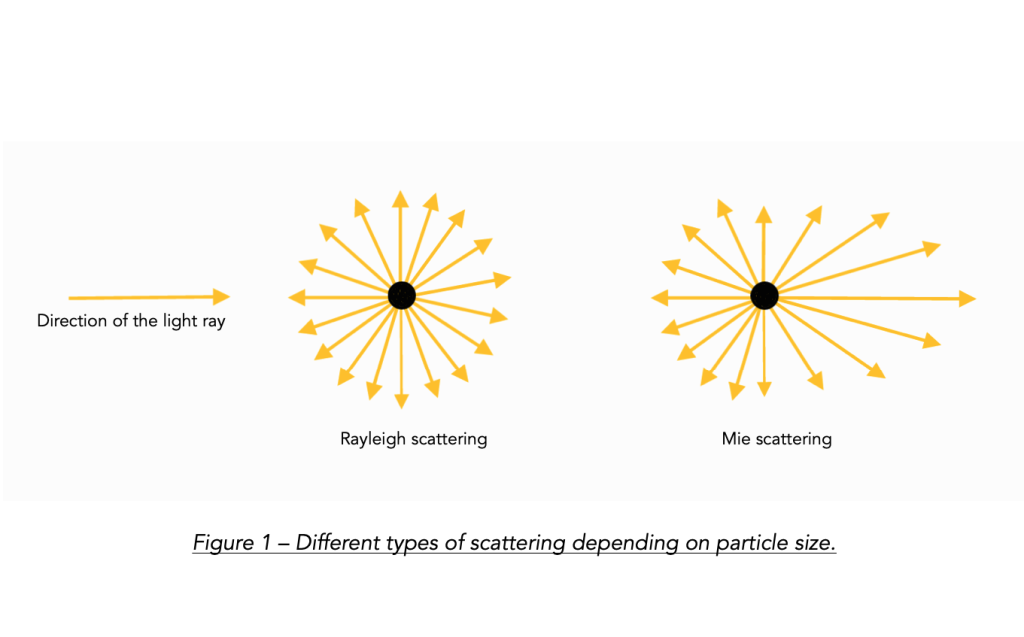
Scattering refers to the deviation of light rays when they encounter structures whose size is comparable to or larger than their wavelength.
Depending on the size of the particles or irregularities within the filter, the process is described as Rayleigh scattering (very small particles) or Mie scattering (larger particles).
These particles locally disperse the light as it passes through the filter, creating part of the luminous halo characteristic of diffusion filters.
Diffraction
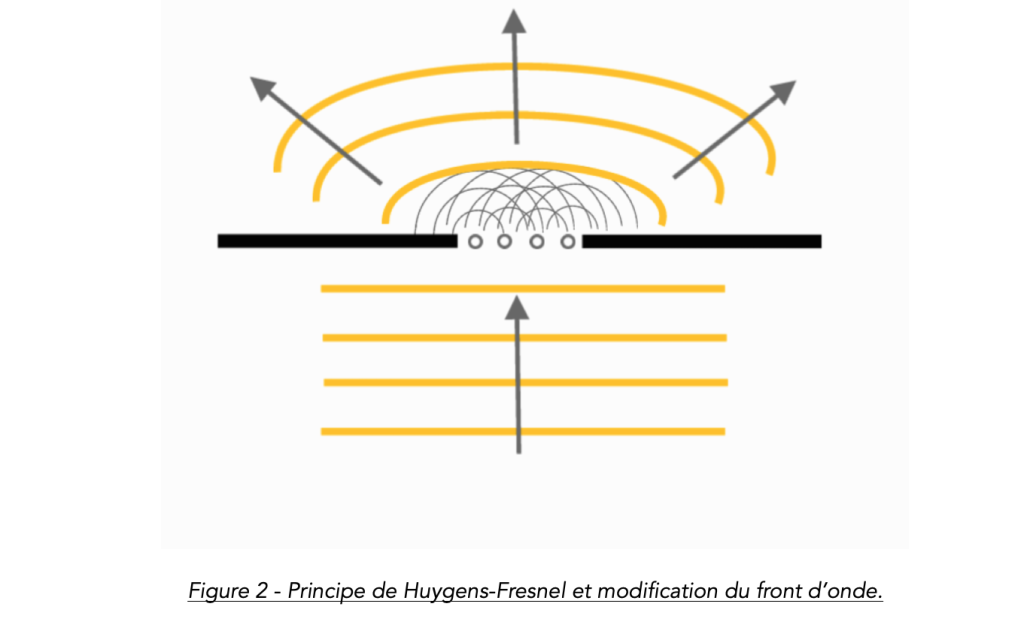
Diffraction describes the behavior of light waves when they encounter an obstacle or an aperture whose size is comparable to, or smaller than, their wavelength. This phenomenon leads to a deformation of the wavefront, which no longer follows a strictly straight trajectory. To explain this deformation, we can refer to the Huygens–Fresnel principle, which states that every point on an incident wavefront behaves as a secondary source emitting elementary waves. These secondary waves interfere with one another, producing a new resulting wavefront whose shape depends on the geometry of the aperture and the local interactions. Figure 2 illustrates this effect: plane waves arrive at an aperture, and the points along its edges act as secondary sources, each emitting spherical waves that overlap to form a new diffracted wave. A diffusion filter composed, for instance, of a pattern structure involves this diffraction phenomenon. When a light ray passes through such an optical filter, it produces a spot that spreads to varying degrees, the form and extent of which are directly determined by the diffracting elements contained within the filter.
Diffusion filter principle
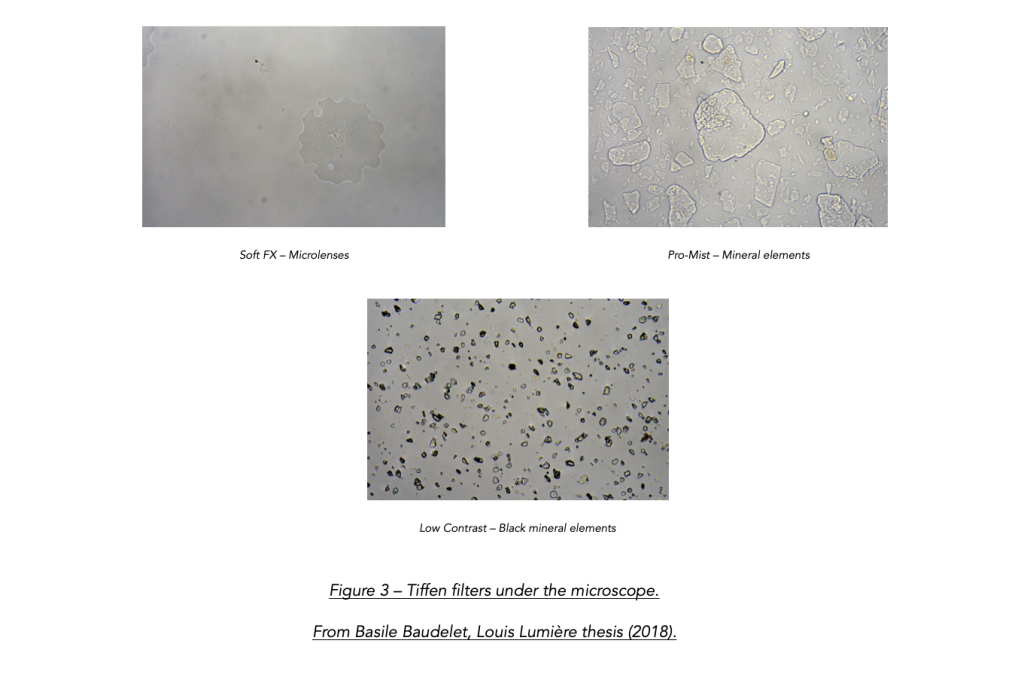
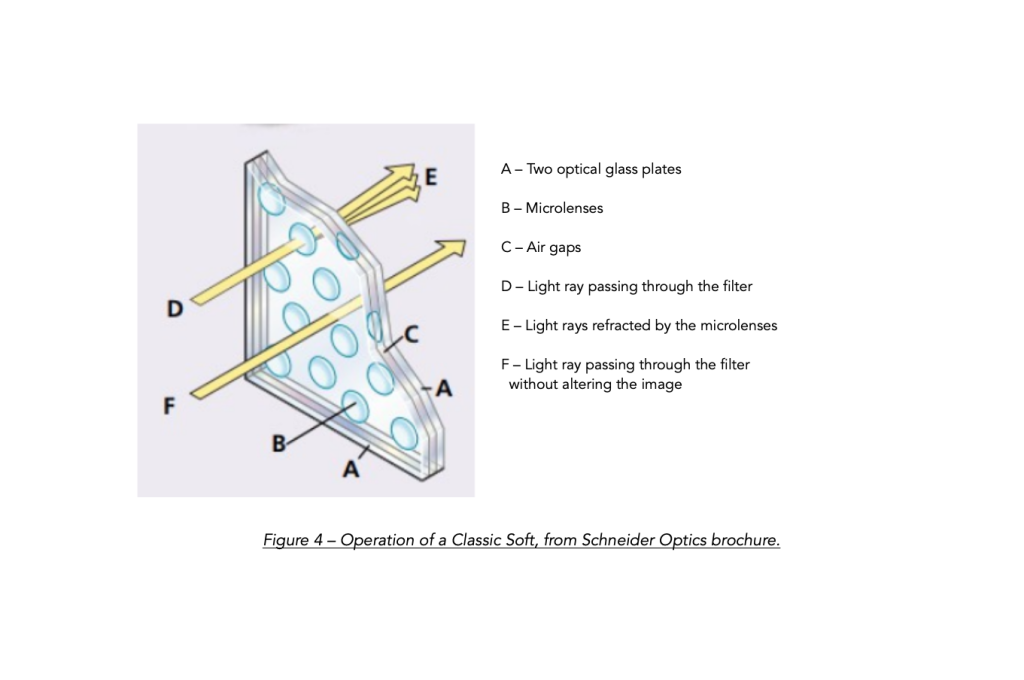
These physical phenomena are at the heart of how diffusion filters work, and adjusting their settings allows you to control how the image is modified. Professional filter brands (Tiffen, Schneider, etc.) generally consist of two glass plates with a structure (micro-lens, screen, etc.) encapsulated between them. Depending on its density, particle size, and spatial distribution, this structure acts as a pattern of irregularities that diffract and scatter light. Microscopic observation of optical filters reveals the composition of the elements that enable light diffusion, refraction, and diffraction.
For example, we can see that certain diffusion filters, such as Tiffen’s Soft FX filters, rely on the use of micro-lenses, which mainly involve the phenomenon of refraction as light passes through. Tiffen’s Pro-Mist filters, on the other hand, are made up of finer, solid structures arranged randomly, which make greater use of diffusion phenomena. Contrast reduction filters (in this case, Tiffen’s Low Contrast filters) incorporate solid dark structures and behave in a manner relatively similar to Pro-Mist filters, with the main effect of enhancing low lights and generating an overall flare on the image. It should be noted, however, that all these observations remain hypothetical, as no precise technical data from the manufacturers is freely available.
The image formed through a diffusion filter can be understood as the overlapping of two images. A sharp image, corresponding to the portion of light that passes through the filter without interacting with the microstructures. And a diffuse image, more spread out spatially, generated by light that interacts with these microstructures, undergoing phenomena of diffusion, local refraction, or diffraction. This overlapping does not alter the focus of the image (sharpness can be preserved locally) but it can cause highlights to spread out and overall contrast to decrease. In practical terms, the filter does not replace the sharp image with a blurred image, but adds a diffuse component to it, which explains why certain areas of the image may remain relatively intact, while the highlights spread around their source.
Diffusion simulation
Diaphanie’s approach
To digitally simulate optical diffusion phenomena, Diaphanie relies on previous observations. As mentioned, diffusion filters are made up of particles whose size and quantity directly influence the extent of the light halo. The first parameter of the diffusion tool, Radius, reflects this idea by allowing you to control the spatial extent of the halo. In the case of optical filters, an increase in the diffusion gradient corresponds to an increase in the size or density of the diffusing particles. Similarly, the Radius parameter is the tool that most closely controls the gradient. It also simulates the effect of increasing the focal length: increasing the focal length is equivalent to “zooming in” on the size of the particles, which results in an enlargement of the light halo.
Using the previous example, the image created by an optical filter can be seen as a mix of the direct image, which doesn’t interact with the filter, and the light halo created by the interaction of light with the filter material. The Strength parameter lets you control the mix between these two images, so it’s a setting for controlling the light intensity of the halo.
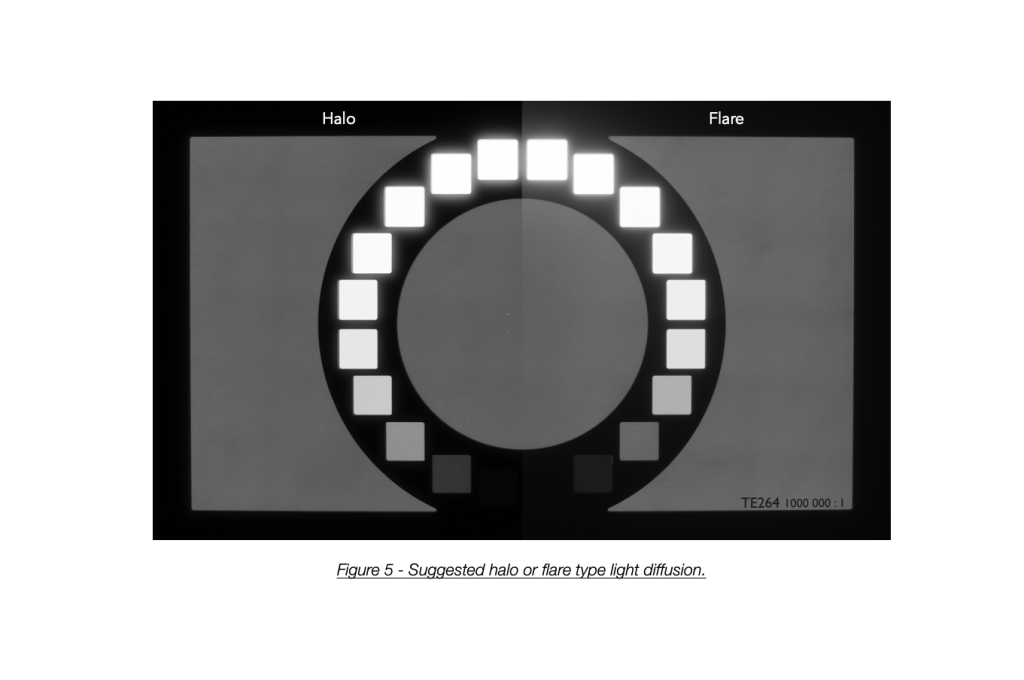
In the different categories of optical filters, we generally find two types that are often opposed by manufacturers: high light diffusion filters and contrast reduction filters. This distinction is based mainly on the nature of the particles involved in the phenomena of diffusion and diffraction. To control this diffusion characteristic, the plug-in includes the Halo vs. Flare parameter. By directing the effect toward the halo, you obtain more localized diffusion, characterized by low dispersion and rapid dissipation of light energy. If, on the other hand, you accentuate the flare effect, the diffusion spreads widely across the entire image, with a more progressive dissipation. This parameter allows you to control both the nature of the diffusion and the dissipation curve of the light energy.
Observation of diffusion filter behavior
To further develop the tool, an experimental protocol was established to analyze the effects produced by different diffusion filters and identify trends. The main goal was to characterize their behavior under specific observation conditions, both on different transparent test charts installed on a light box (neutral gradient chart, high-contrast straight-edge chart, spatial resolution chart) and in real scenes including spot or diffuse light sources, with both high and low contrast.
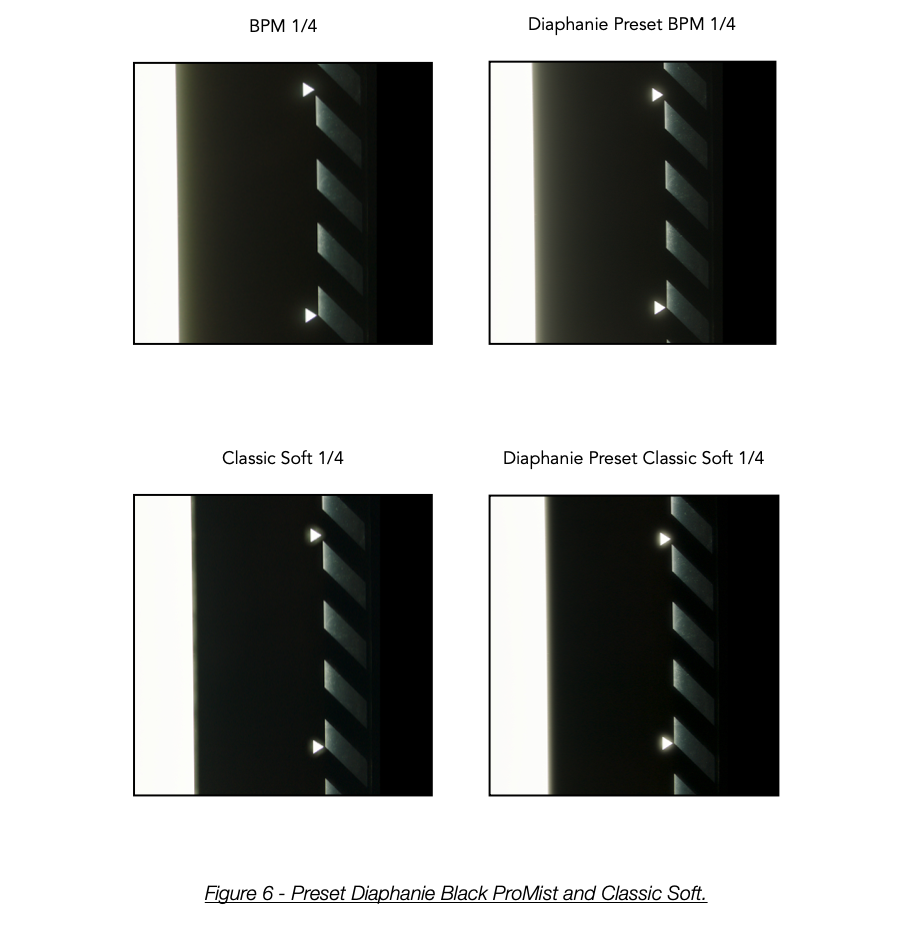
The data collected made it possible to identify diffusion signatures specific to each type of filter tested and to integrate these results in presets. When a preset is selected in Diaphanie, it is not an obscure process but rather a coherent set of values for the Radius, Strength, and Halo vs. Flare parameters. This allows the user to adjust these values according to the image and the desired effect.
Progression of the filter gradient
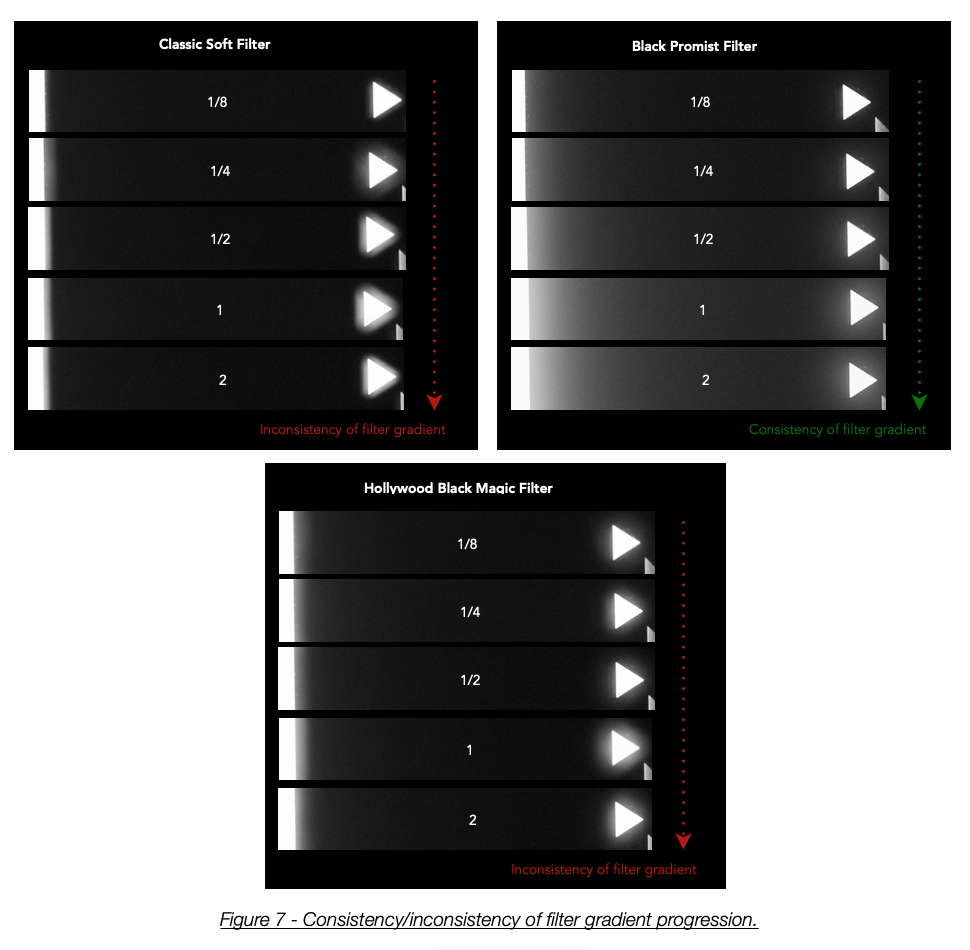
One of the interesting observations emerging from these tests is the lack of consistency in the gradation of some filters. Despite a precise protocol and rigorous control applied to several series, some show random variations in the diffusion phenomenon. The example below in figure 8 clearly illustrates this lack of continuity, which can be observed in both Hollywood Black Magic and Classic Soft filters, where unpredictable variations or exceptions in the progression appear. In contrast, the Black Promist series is much more consistent and progressive in the evolution of its gradients. These results raise questions about the reliability of these tools, highlight their complexity, and reinforce the idea that it is necessary to test and verify them before assuming their gradation by default. Diaphanie decided to rely on the overall trend of the filter when creating presets in order to guarantee gradation that can be adjusted according to the image.
Diffusion Enhancements
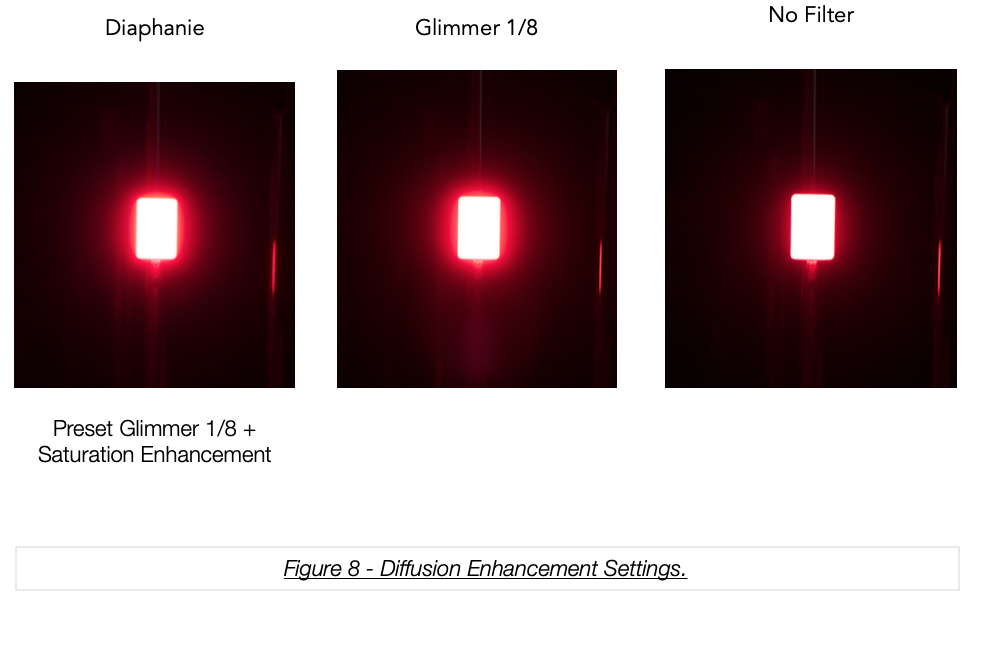
When shooting with an optical diffusion filter, the light halo is colored by the highlights that cause it. This phenomenon becomes difficult to simulate digitally when these highlights reach the sensor’s saturation point (saturation luminance Hsat). In order to approximate real photometric behavior in this case, or simply to provide more control over the color of the halo, Diaphanie offers a series of parameters grouped under the term Diffusion Enhancement. The color temperature and saturation enhancement settings allow you to control the hue and saturation of the halo. Figure 8 illustrates the influence of these parameters on the hue of the halo in a high-contrast, high-saturation scene.
Loss of resolution
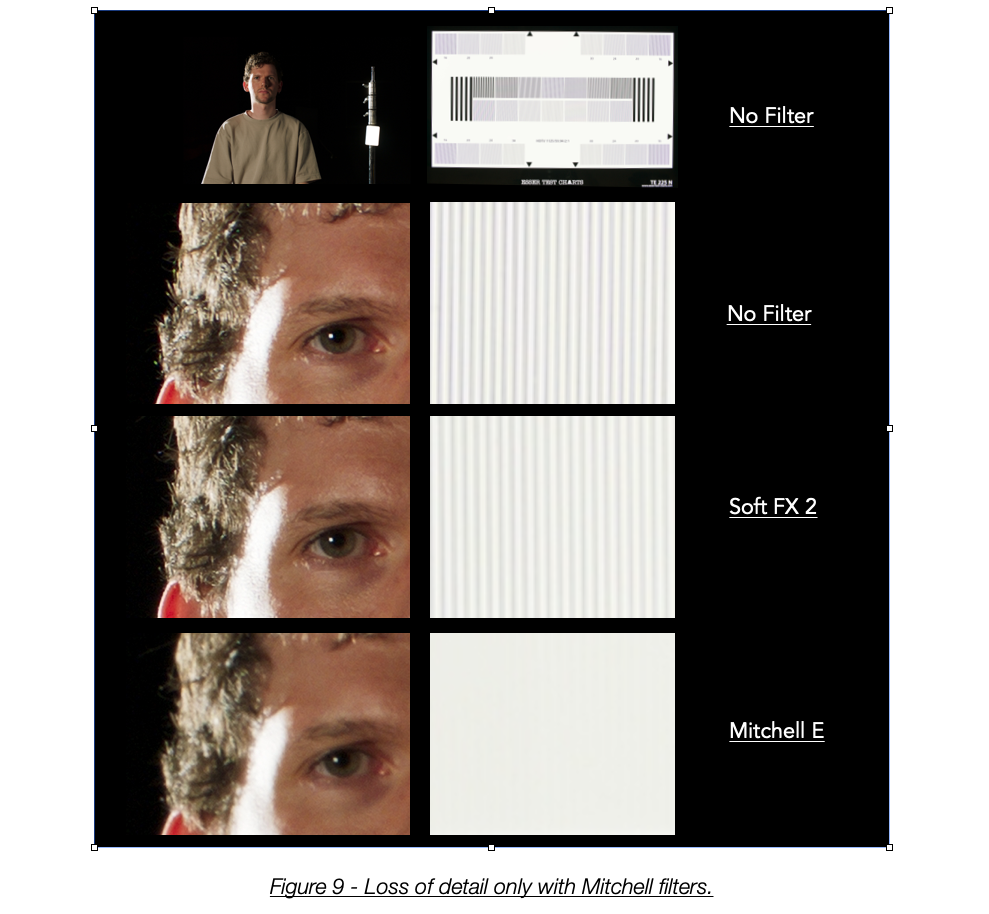
Each series of filters analyzed was also tested to measure the loss of detail on a transparent test chart with different spatial frequency levels (TE225D chart). The purpose was to determine if the filters reduced the perception of detail, in other words, if they caused a decrease in contrast in the high spatial frequencies. Since the camera-lens combination (Alexa Mini 3.2K OG + Arri Master Prime T1.4) already reached the limit of its resolution power in the areas of the test chart with the highest spatial frequency (the finest details in the image), the addition or omission of a diffusion filter did not change this limit for most of the series tested. Only the Mitchell series truly changed this resolution boundary, making it the only series tested that actually alters image detail. For some filters, a change in contrast was observed, but this only affected the low frequencies of the image (uniform and flat areas). Finally, we can conclude that standard diffusion filters do not affect the ability of the sensor and lens to discern fine image details, but that certain series accentuate the loss of contrast at low frequencies. To allow this parameter to be adjusted, Diaphanie includes a Spatial Equalizer tool that makes it possible to modify the rendering of details according to their spatial frequency.